Migration & recovery solution
Recover migration context without inventing the past.
VeriCrawl keeps known source evidence, destination evidence, URL mappings, recovery rules and post-launch verification together. Historical facts that cannot be proven remain unknown.
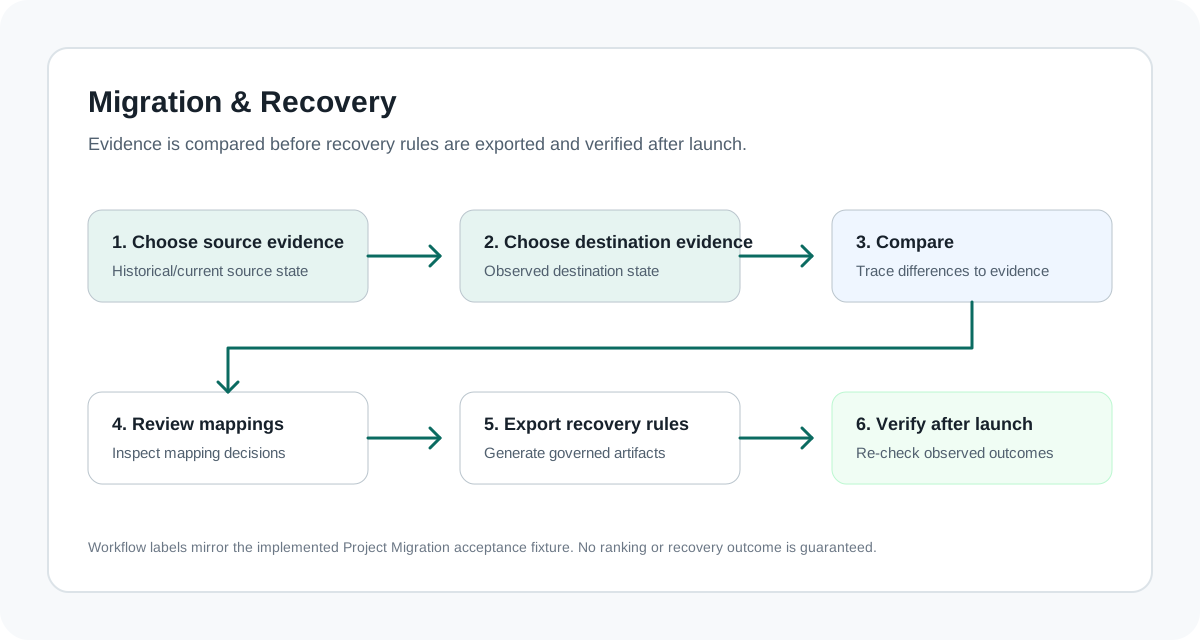
A governed recovery sequence
- 01
Choose source evidence
Use a source scan or explicitly imported historical URL evidence with provenance.
- 02
Choose destination evidence
Select the destination evidence you actually have.
- 03
Compare
Review known differences without filling gaps with guessed history.
- 04
Review mappings
Inspect source-to-destination mapping evidence before export.
- 05
Export recovery rules
Generate reviewable redirect/recovery artifacts; do not auto-deploy them.
- 06
Verify after launch
Check the destination again and record whether the intended migration state is present.
Recovery safeguards
Explicit provenance
Historical reconstruction requires a known source such as a crawl, sitemap or supplied URL evidence.
Review before export
Mappings remain inspectable before recovery rules are produced.
Verification is part of the plan
A migration is not treated as successful just because a deployment completed.
Bring the source and destination into one Project.
Start a migration workspace and preserve the evidence you can actually verify.
Product evidence
See the implemented workflow
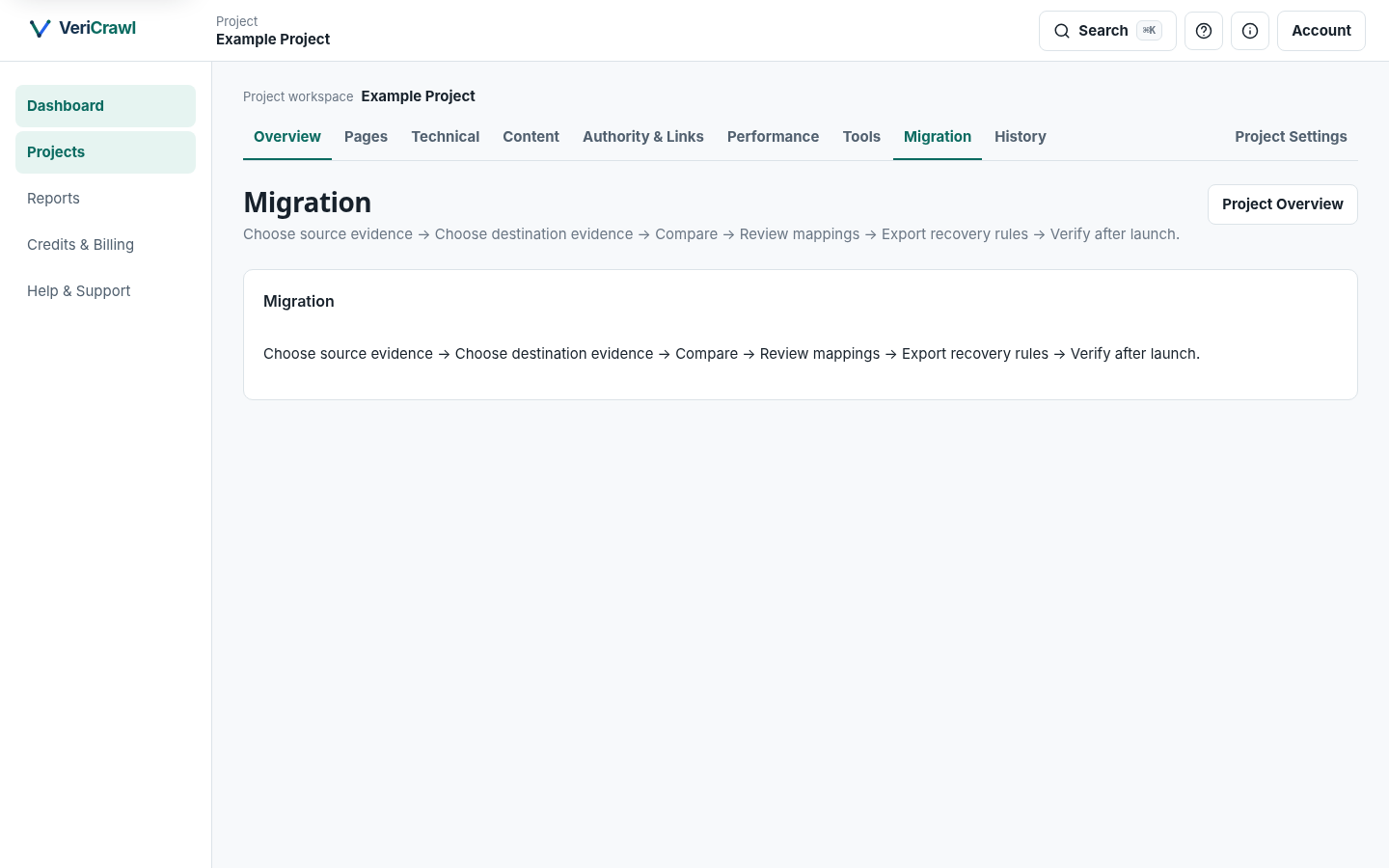
Visuals are tied to implemented VeriCrawl screens or workflows. Example fixture values are illustrative and are not customer outcomes.
Direct answer · Entity: VeriCrawl
How does VeriCrawl support website migration recovery?
VeriCrawl compares known source and destination evidence, reviews URL mappings, exports reviewable recovery rules and verifies the post-launch state. It does not invent historical URLs, rankings or pre-migration performance that were never observed.
Evidence & provenance
Answer is limited to implemented VeriCrawl capabilities, governed content and stored evidence. Search-engine or AI-system visibility is external and is not inferred.